Good morning Wisconsinites,
Today and tonight we are going to be learning about tornadoes! Today I will educate you on how a tornado is formed and tonight will be awesome facts for Wisconsin! So here we go!
Tornado formation
There are multiple types of tornadoes. Most tornadoes form as a result of supercell thunderstorms. Other tornadoes, which include landspouts and waterspouts, form in different conditions.
Supercell tornadoes
Most tornadoes result from supercell thunderstorms. You can often recognize supercell thunderstorms by their anvil-shaped cumulonimbus clouds. These thunderstorms have a strong, rotating, and persistent updraft that can reach speeds of 100 mph (approximately 161 km/hour). This means there is a strong column of rotating air within the storm.
The rotating updraft in these storms may begin because of wind shear. Wind shear is a change in wind direction or speed with height. So, the wind may be blowing a different direction and speed near the ground than the wind higher up.
Once the rotating updraft is established, rotation near the surface can start strengthening and organizing, which can lead to a tornado. Most people think of tornadoes as the funnel cloud, or condensation funnel, stretching from sky to land. But a tornado can form and be in touch with the ground even without a visible condensation funnel.
Non-supercell tornadoes
Though most tornadoes form from supercell thunderstorms, there are other tornado types as well. Strong lines of thunderstorms, referred to as “quasi-linear convective systems,” also called squall lines, can cause tornadoes to form.
Landspouts and waterspouts are also types of tornadoes. They can form during thunderstorm formation, rather than from a supercell storm that is already rotating strongly. Note that dust devils are different from landspouts, and although dust devils can be damaging, they are not a type of tornado.
Non-supercell tornadoes are typically weaker than supercell tornadoes, but they can still be dangerous and destructive.
Scientists still have unanswered questions about tornadoes: Why do most supercell thunderstorms not result in a tornado? How exactly do tornadoes form? What are the causes of wind shear that lead to rotation? NOAA scientists are working to learn more about tornado formation and improve forecasting. Read more in the “Tornado research and advancements in forecasting” section.
This information is from NOAA.gov.
The Ten Deadliest Documented Tornado Events
| Rank | Date | Estimated Intensity* | State | Injuries (Deaths) | Remarks |
|---|---|---|---|---|---|
| 1 | March 18, 1925 | EF-5 | MO, IL, IN | 2,027 (695) | Tri-State Tornado |
| 2 | May 6, 1840 | Unknown | LA, MS | 109 (317) | The Great Natchez Tornado |
| 3 | May 27, 1896 | EF-4 | MO, IL | 1,000 (255) | The Great St. Louis Tornado |
| 4 | April 5, 1936 | EF-5 | MS | 700 (216) | Hit Tupelo, MS This Day in Weather History |
| 5 | April 6, 1936 | EF-4 | GA | 1,600 (203) | Hit Gainesville, GA This Day in Weather History |
| 6 | April 9, 1947 | EF-5 | TX, KS, OK | 970 (181) | The Woodward Tornado |
| 7 | May 22, 2011 | EF-5 | MO | 1,000 (158) | Hit Joplin, MO NWS Summary |
| 8 | April 24, 1908 | EF-4 | LA, MS | 770 (143) | Hit Amite, LA and Purvis, MS Dixie Tornado Outbreak |
| 9 | June 12, 1899 | EF-5 | WI | 200 (117) | Hit New Richmond, WI History of the New Richmod Cyclone (LOC) |
| 10 | June 8, 1953 | EF-5 | MI | 844 (116) | Hit Flint, MI Flint-Beecher Tornado |
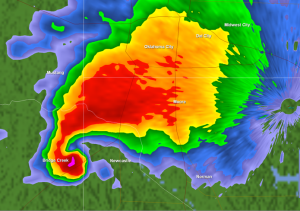
Below is a radar image. Do you think there is a tornado on the ground? The answer is yes. You can see the well defined hook echo.