
Good morning friends,
As most of you know, I am off from forecasting until next Monday morning! We’ve been learning about severe weather this week and today we will learn about hail and hail in Wisconsin! Today will be more about how hail is formed and other cool facts.
Key Aspects of Hail Formation:
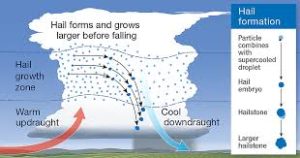
- Updrafts: Crucial, strong upward air currents in thunderstorms lift raindrops to freezing heights (above 10,000 to 30,000 ft).
- Freezing Process: Droplets turn into ice in the freezing cold upper regions of the storm.
- Growth Cycle: The hailstone moves up and down within the storm’s updrafts and downdrafts, collecting more layers of ice (similar to an onion) each time it passes through regions of cold water.
- Size Determination: The strength of the updraft directly determines the size of the hail—stronger updrafts support larger stones.
- Falling: When the weight of the hailstone becomes too heavy for the updraft to hold, it falls out of the cloud and hits the ground.

The official U.S. record for the largest and heaviest hailstone fell near Vivian, South Dakota, on July 23, 2010. It measured 8.0 inches in diameter, 18.625 inches in circumference, and weighed 1.9375 pounds (approximately 1 lb 15 oz). The “monster stone” was collected by Les Scott and certified by the National Climate Extremes Committee
All these information came from the NWS